Structural Analysis
A-) Structural Analysis-Static/Dynamic
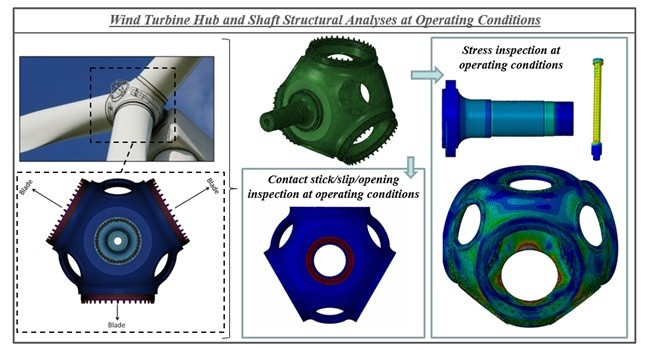
SDM is capable of performing structural CAE analysis to simulate operating conditions for any system. This enables the design engineers to avoid any possible failure state before the system is anything more than a CAD model. SDM structural CAE engineering services include linear/nonlinear static stress analysis, transient stress analysis, low cycle-high cycle fatigue analysis, sequential/coupled thermal stress analysis and the analysis of fluid-structure interactions. Our engineering team is capable of modeling and analyzing complex systems in a large variety of fields, including turbo-machinery (harsh operating conditions at high rpm), automotive (crankshaft durability, engine bottom end stress analysis, durability of accessories, chassis components, exhaust systems etc.), biomedical, energy systems, etc. Our company’s vision is to deliver safe, optimized systems and our structural analysis capabilities are a major part of that vision.
A-1) Linear/Nonlinear Static Stress Analysis
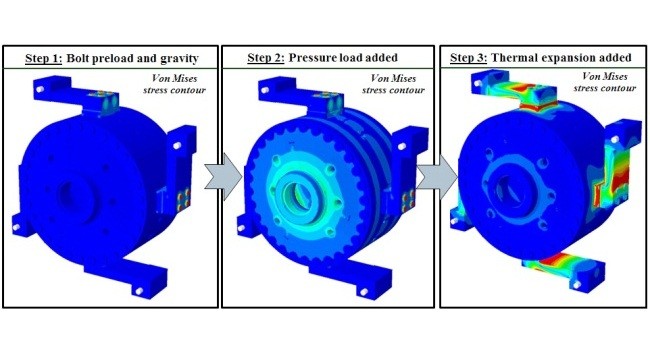
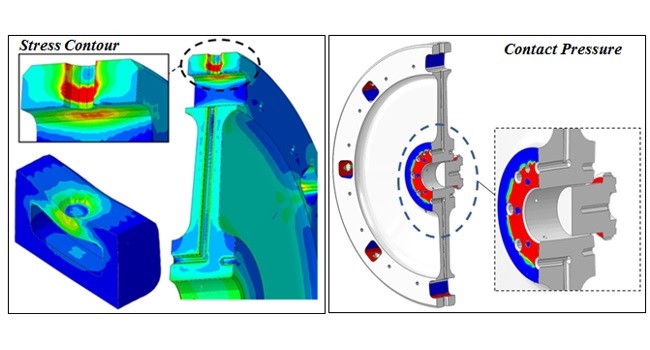
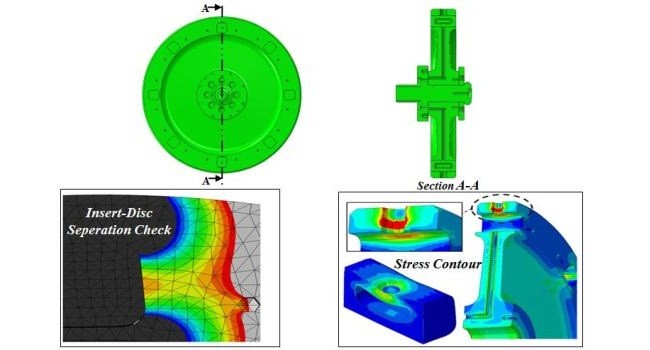
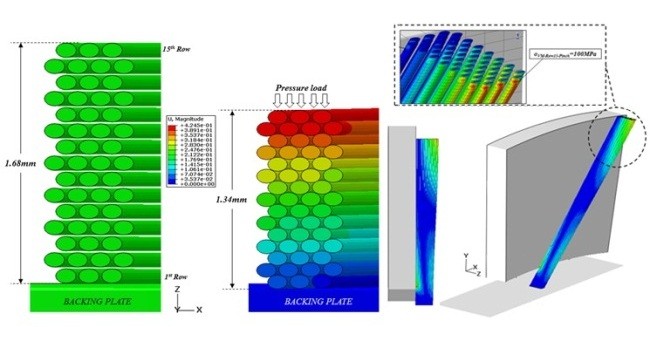
Linear/Nonlinear static stress analysis is performed to check the static failure characteristics of given systems that operate under loads that have a constant magnitude and direction. First, the analysis starts with component level simulations, and then a system level analysis is performed to simulate real life conditions. Assembly loads (bolt preload, interference fit loads etc.), interactions between bodies (hard contact with friction, conditional couplings, radial/journal bearings etc.) are all included in the system level analysis, which enables a high fidelity simulation of real life conditions. The analysis results are then used for design modifications when the computed safety factors of any component are at a critical level. Optimization procedures (topology, topography, size and shape optimization procedures, DOE studies and multi-disciplinary optimization through a meta-model) can then be ran to obtain safe systems at a minimized cost.
A-2) Transient Stress Analysis
Transient stress analysis procedures are applied when a system’s transient effects are important. These procedures usually include sequential/coupled simulations, and thermal and/or CFD analysis. All interactions and couplings are included in the system level analysis, in order to foster high confidence levels in the CAE models. The analysis results are then used for design modifications when the computed safety factors of any component are at a critical level.
A-3) Fatigue analysis (low cycle/high cycle)
A low/high cycle fatigue analysis is run for systems that operate under dynamic loads. This analysis is performed by including both assembly and dynamic loads. The endurance limit safety factors are also computed for high cycle fatigue problems. Low cycle fatigue problems are also simulated, especially when thermal cycles are a factor in the system’s operation. The effects of mean stress, surface roughness, size, reliability, and manufacturing methods on the fatigue safety factor are all included in the fatigue analysis.
A-4) Sequential/Coupled Thermal Stress Analysis
Multidisciplinary simulation procedures are applied as sequential/coupled thermal-stress analyses. The effects of elevated temperature and thermal expansion are included in stress analyses by using sequential/coupled thermal stress analysis procedures. Sequential/Coupled transient analysis is introduced when rapid heating/cooling problems are encountered. The system’s thermal gradients and induced deformations are computed, and design modifications are made for systems that have safety factors below the target value.
A-5) FSI-Fluid Structure Interaction
SDM is capable of simulating Fluid-Structure Interaction, where CFD and structural CAE analyses are run and coupled with each other. FSI procedures enable the simulation of systems where the thermal and flow characteristics of the fluid affect structural deformations and vibrations, and vice versa.
B-) Structural Analysis - Thermal
SDM’s engineering team is experienced in the analysis of the effect of thermal gradients on structural systems, and is capable of calculating thermal distributions in any system. Structural thermal analysis procedures are not limited to steady state and transient thermal analysis. They also cover sequential/coupled thermal stress analysis, which enables the computation of thermal effects on a structure’s deformation and stress distribution. Thermal and sequential/coupled analyses help simulate harsh operating conditions accurately, which in turn yields high fidelity in CAE models.
B-1) Steady State Thermal Analysis
A steady state thermal analysis is run to compute the temperature distribution in a structure. The 3-D heat conduction within a solid body and the thermal contact between different parts of the structure are included in the structure’s steady state thermal analysis. The convection of the fluid medium, isolated and/or thermal boundary conditions, and the initial temperature fields are all modeled and simulated in the thermal analysis.
B-2) Transient Thermal Analysis
A transient thermal analysis is introduced when rapid heating/cooling conditions are encountered by a system. The thermal gradients and temperature distribution vs. time are computed during the transient thermal simulation of a system.
B-3) Sequential/Coupled Thermal Stress Analysis
Multidisciplinary simulation procedures are applied with sequential/coupled thermal-stress analyses. The effect of elevated temperatures and thermal expansion are included in the stress analysis by using the sequential/coupled thermal stress analysis procedure. Sequential/Coupled transient analysis is introduced when rapid heating/cooling problems are encountered. Thermal gradients and induced deformations are computed, and design modifications are made for systems that have safety factors below the target value.