NVH
SDM R&D's abilities include Noise-Vibration-Harshness analysis at the component and system levels, and NVH development and optimization. SDM’s engineering team is experienced in Engine and Powertrain NVH modeling, analysis and optimization, modal/frequency response analysis, power spectral density analysis of structures, and also in multi-body dynamics. The main company vision is to deliver NVH solutions in the design phase to meet the requirements of our customers.
Modal Analysis
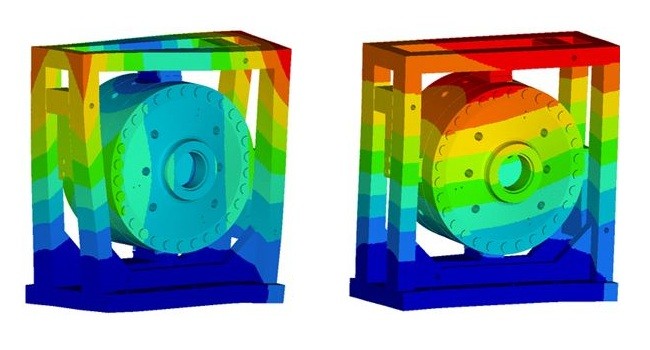
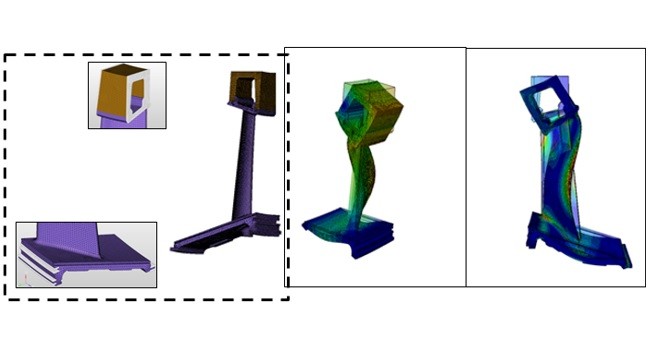
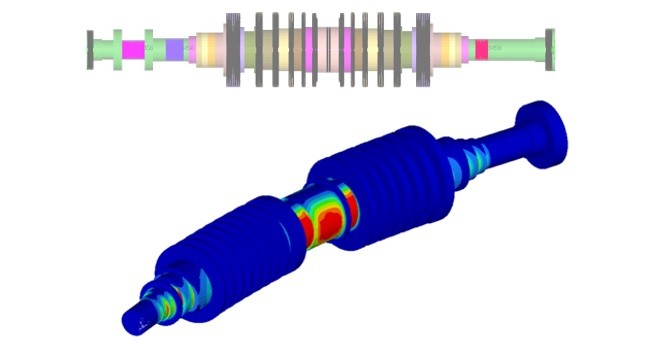
Modal analysis is performed to extract the mode shapes and resonant frequencies of the analyzed entity. System-level free vibration analysis and its results are supplemented with white noise frequency response analysis in order to identify driving modes and local/global modes of structures with many components, such as powertrains. Modal participation factors can also be extracted in order to examine the contribution of modes on the total system’s response for further vibration analysis. SDM’s engineering services also include NVH optimization (topology, topography, size and shape optimization procedures, DOE studies, and multi-disciplinary optimization through a meta-model) which improves a system’s modal characteristics with respect to targets set by the customer.
Modal/Direct Frequency Response Analysis
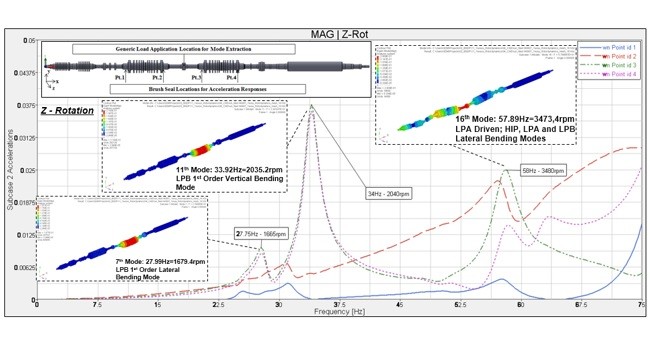
Frequency response analysis is performed using operating forces and/or enforced motions to compute the vibration levels of systems. Acceleration and/or displacement results are reported as magnitude-phase diagrams in the frequency domain. Order analysis can also be performed to examine the system’s response at operating rpm's, which is very useful, especially in powertrain applications. Identifying the mode-driven peaks in the system, determining the weak points in the product, and modifying the design to improve the vibration response of the system are the main steps in our NVH improvement studies. It is also possible to perform NVH optimization (topology, topography, size and shape optimization procedures, DOE studies and multi-disciplinary optimization through a meta-model) to reduce vibration levels, by providing objectives that are determined by customer demands.
Power Spectral Density (PSD) Analysis
Power Spectral Density (PSD) analysis is performed for structures that are excited by random loads (such as the road and wind loads on a vehicle chassis). Vibration responses of the analyzed entities are computed as power spectral densities. The results are post-processed to examine the system’s response, and a risk assessment is performed by comparing the results with customer targets. These PSD analysis procedures are not only used in NVH analysis, they are also the preferred parameters in a durability analysis when the operating loads are random.